B
Wide-body vs narrow-body: telling them apart on an apron from overhead imagery
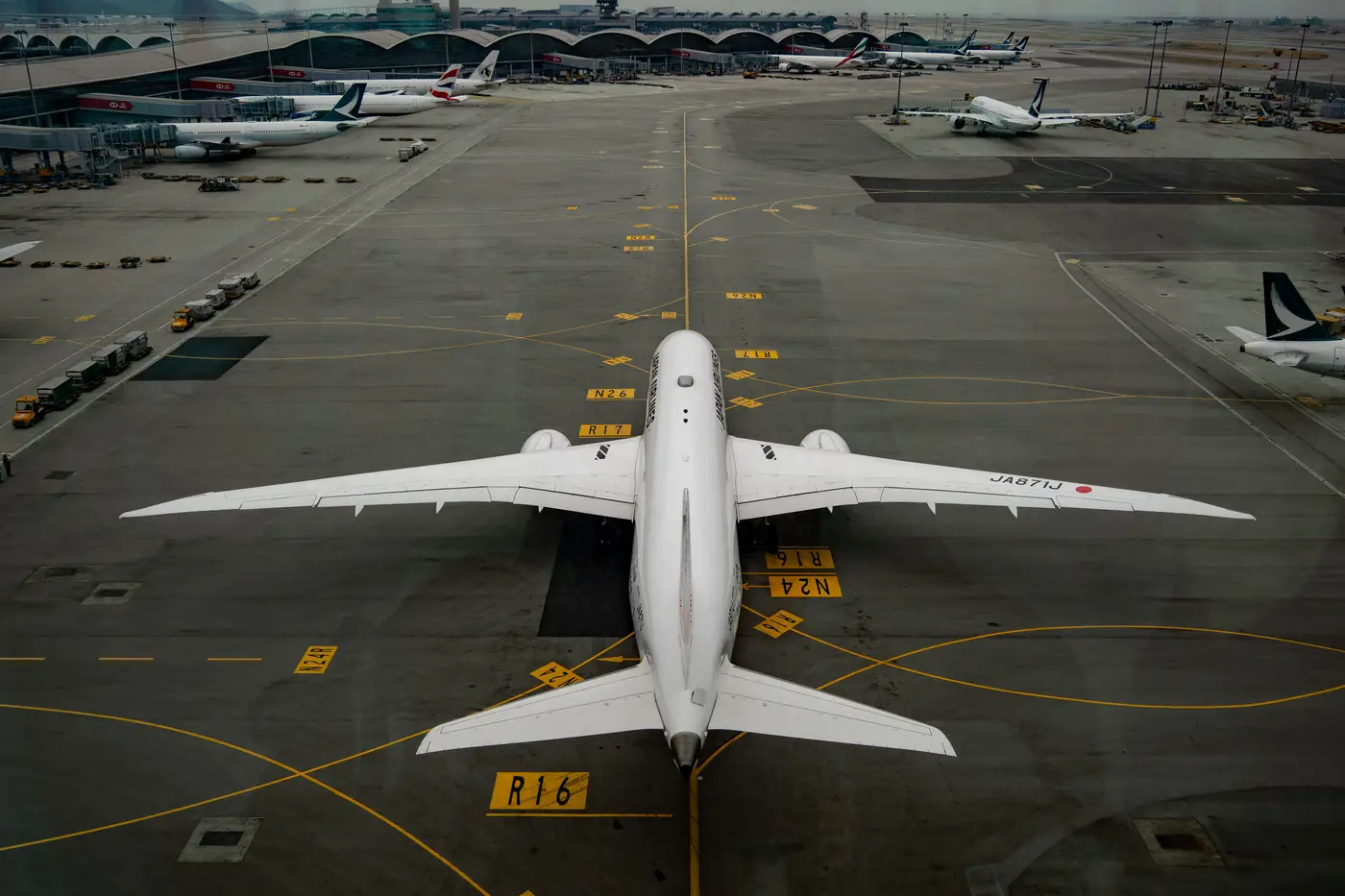
If you're trying to read base activity from a satellite pass instead of a ground contact, the first question is usually the simplest one: is that a wide-body or a narrow-body sitting on the stand? For a utilization read, what matters is the broad type, repeated daily, across every stand on the apron.
Here's what separates the two classes when you're looking straight down.
Fuselage length is the first tell, but it's not enough alone
A narrow-body, your 737s, A320s, E-Jets, runs roughly 30 to 45 meters nose to tail. Wide-bodies start around 50 meters and climb past 70 for a 777 or A350. At 0.5 m GSD that length difference is obvious once you've got a few aircraft on the same apron to compare against. The trap is using length by itself on an isolated aircraft with no reference nearby. A stretched narrow-body and a shorter wide-body variant can land close enough in raw length that you'll second-guess yourself. Length narrows the call, but it doesn't close it.
Wingspan and wing shape close the call
This is the more reliable cue. Narrow-body wings top out around 36 meters span and read as a fairly straight, moderately swept planform from overhead. Wide-body wings run 55 to 65 meters and the sweep is more pronounced, with a visibly thicker wing root where it meets the fuselage. Lay the wingspan against the fuselage length as a ratio rather than reading either number in isolation, and the two classes separate cleanly even on aircraft you've never catalogued before. A wide-body's wings look like they belong to a bigger airplane relative to its body. That's the shape your eye should be trained to catch before anything else.
Engine count and position back up the read
Most of what's parked on a commercial apron is twin-engine regardless of class, so engine count alone doesn't do much sorting. Position does. On a narrow-body the engines sit tucked close under the wing, close to the fuselage. On a wide-body they're mounted further outboard and hang noticeably lower relative to the wing chord, which shows up as a longer shadow off the nacelle in morning or late-afternoon passes. If the fuselage-to-wingspan ratio leaves you on the fence, the engine shadow geometry usually settles it.
Use what's already on the apron as a ruler
You rarely need to guess at scale from nothing. Jet bridges, GSE, and apron markings give you a built-in reference. A standard jet bridge is close to a known width, so an aircraft that dwarfs the bridge it's parked at is almost certainly a wide-body, and one that the bridge looks proportionate to is almost certainly narrow-body. Remote stands without a bridge are harder, which is where shadow length comes in: at a known sun angle and time, shadow length is just fuselage length with an extra step, and it's a useful cross-check against a stand that looks ambiguous from the top-down footprint alone.
Resolution is the floor under all of this
None of these cues hold at imagery coarser than roughly a meter per pixel. Below 0.5 m you start losing the wing-root thickening and the engine shadow separation that make the call reliable, and you're back to guessing off silhouette alone. This is also why a one-off tasking rarely tells you much. A single clear day on one apron gives you a type-read for that day. What a fleet analyst or lessor needs is the same read repeated daily, so a gap in utilization or a sudden cluster of wide-bodies on a storage apron shows up as a pattern instead of a guess.
That daily, dated count, broad type against stand against date, is what Aircraft Counting builds from VHR imagery for aprons you can't put a spotter at every day. If you're tracking parked-fleet activity at a base you don't have eyes on, it's worth a look.